
Yiwu Kitchenware Market: The Complete Buyer’s Guide
Most Yiwu market guides are written by sourcing agents who need the market to sound magical. Here's the version I'd have wanted when I was on the other side of the table — buying housewares for Auchan and Magnit's retail programs, with a margin target to hit and a QC department behind me.
What "Yiwu market" actually means
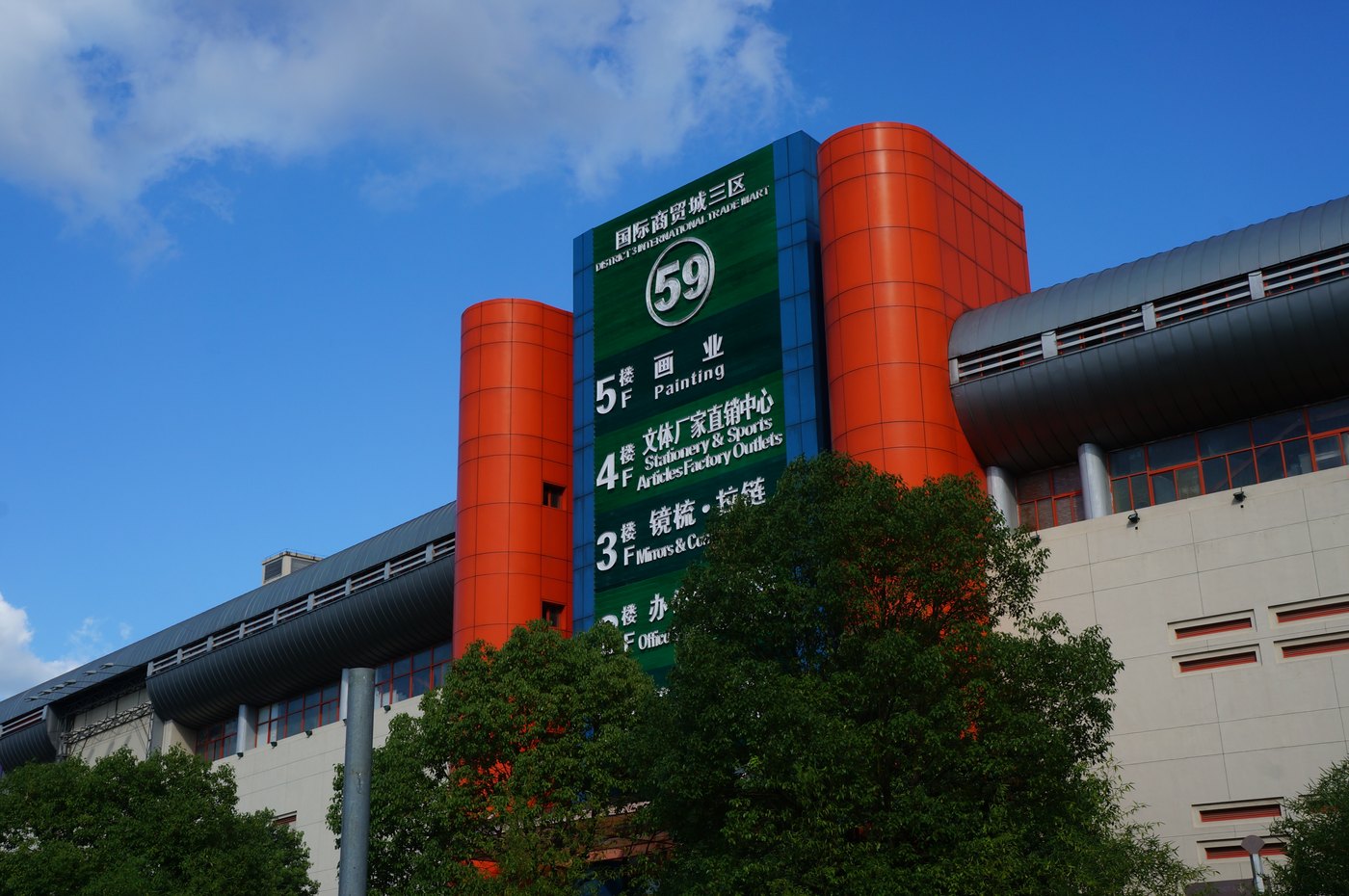
"Yiwu market" almost always means Yiwu International Trade City (locals say Futian market, 福田市场) — five connected districts holding roughly 75,000 booths, the largest wholesale complex on earth. Walk it end to end and you've covered several kilometers without leaving a building.
The broad-strokes district map:
| District | What lives there |
|---|---|
| District 1 | Toys, flowers, jewelry, accessories |
| District 2 | Hardware, electrical, and kitchenware & small household |
| District 3 | Stationery, office, glasses, cosmetics |
| District 4 | Daily necessities, socks, textiles — parts of storage & cleaning live here too |
| District 5 | Imported goods, bedding, auto accessories |
For kitchenware, storage, and cleaning goods, you'll spend most of your life in District 2, with excursions into District 4. Booth addresses read like coordinates — "2F, Gate 19, Booth 21053" — and after a day they start making sense.
Plan a manageable shortlist and leave time to record specifications, evidence and next steps; the useful daily booth count depends on your category and preparation.
Getting here, and when to come
Before travel, check current transport schedules and the precise market address with official operators; allow time for transfers rather than relying on a fixed journey estimate.
Confirm current opening and holiday arrangements with the market before booking; plan separate time for discovery, shortlisted meetings and any authorised factory visit.
When to come — the calendar that actually matters:
- Late January–February: the market effectively closes for 2–3 weeks around Chinese New Year (dates shift yearly), and factories stop for longer. If your Q1 stock depends on a January order, you're already late.
- March–April: post-CNY restart. Factories hungry, good negotiating season, new-year catalogs out.
- October: the Canton Fair pulls suppliers' attention south; Yiwu stays open but key people travel.
- August–October: Q4 production crunch — quotes are fine, but production slots are the scarce commodity.
Full visit logistics — hotels, visa notes, the CNY calendar — live on our Plan Your Visit page.
What a booth actually is
Fewer than one in five booths is a factory. Most are trading companies or factory sales offices displaying a curated selection, with production happening in Yongkang, Jieyang, Taizhou and the industrial belt around Yiwu. That's not a scam — it's the market's design. A booth is a showroom and an order desk, not a warehouse and not a production line.
This changes three things for you as a buyer:
- The price on the shelf is a stock/wholesale price, not your production price (more on the three prices below).
- The sample on the shelf and the goods your order produces can come from different factories entirely.
- "We are factory" is the market's most common English sentence. The follow-up that matters: which factory, where, and can I visit it? The twenty-minute license check answers what the booth won't.
None of this makes the trading layer bad. A good consolidator is genuinely useful — that's literally the business I run. The point is knowing which layer you're talking to, because it decides what the price means and what promises are enforceable.
The three prices (the concept that pays for this article)
Every kitchenware SKU in this market has at least three prices, and most first-time buyers compare their quote against the wrong one:
1. The booth stock price — cash-basis RMB for goods sitting in a warehouse now. Lowest friction, small quantities, zero customization. This is the price tag you see.
2. The order price — what the booth quotes for a produced order at your quantity, with your packaging, export-ready. Higher than the stock tag, because now production, packaging, and paperwork exist.
3. The factory price — what the producing factory would quote a direct, qualified, volume buyer. Lower than the order price by the trading layer's margin; available only if you are that buyer, which at container-a-year volumes you usually aren't — and the layer you'd be cutting out was doing real work.
A booth stock price, an export quotation and a factory quotation can cover different quantities, packaging and trade terms; compare them only after those assumptions match.
The professional move: always ask which price you're looking at, and normalize quotes to FOB with packaging spec before comparing anything. The landed-cost math starts one row further down than most buyers think.
What moves the price in each product group
We don't publish price ranges here. They move with material costs, quantity and season, and a stale range misleads more than it helps. These are the fields that explain most of the gap between two booth prices for the same-looking item; compare them before you compare the number.
| Product group | Fields to compare |
|---|---|
| Silicone tools | Formulation claim, components, intended use. |
| Stainless tools and bowls | Declared grade, gauge, weight, finish and packing. |
| Plastic storage and boards | Declared material, dimensions, wall thickness, function and packing. |
| Cleaning products | Dimensions, actual weight, material blend, moving parts and packaging. |
A quote far below the others usually means a different spec, most often the material. A quote far above may mean a better spec, or an extra trading layer.
How MOQs really work here
- Booth stock: 5–10 cartons per SKU, pay and ship. This is why wholesalers worldwide love Yiwu — mixed containers assembled in days.
- Light customization (your label, polybag, color box): usually 300–1,000 pcs per SKU, driven by the packaging component.
- Real OEM (logo on the product, spec changes): 1,000–3,000 pcs and up — a production line is now involved, not a shelf.
The insight most first-timers miss: MOQ is a price curve, not a wall. Almost every "MOQ 2,000" has a 500-piece price — higher, and the negotiation is finding out how much and why. Ask for three quantity tiers, know that half of all MOQ standoffs are secretly packaging-print standoffs, and remember that a factory pushed below its real cost floor recovers the loss somewhere you can't see.
Working the booths: communication, capture, etiquette
For custom requirements, arrange competent language support and record the specification in writing; confirm a translator’s actual scope, rate and availability in advance.
WeChat is the operating system of this market. Every booth transacts, quotes, and sends photos through it. Get the QR code at every booth that interests you; the follow-up conversation is where real numbers appear, not at the counter.
Photo etiquette: ask before photographing displays. Most booths are fine with it once you're clearly a buyer; some ban it because their displays get cloned. A blocked camera is market information too.
My capture routine — eight fields per booth, every time: booth number and name / boss's WeChat / factory-or-trader (and where the factory is) / three main SKUs photographed with prices / MOQ / lead time / export certifications held / packaging data available yes-no. Thirty seconds of discipline per booth turns a market walk into a database. Without it, by booth forty you remember nothing.
Samples: Yiwu's quiet superpower
For stock items, you can buy the booth sample and walk out with it the same day — pay a retail-ish price, done. Compare that to the two-to-three-week factory sampling loop and you understand why product people love this town: an afternoon in District 2 can fill a suitcase with a whole category's competitive landscape.
For custom items, normal rules apply: sample cost plus courier, usually credited against the order. Either way, the discipline that matters comes later — a sealed, signed golden sample before mass production, because the booth display is the best piece ever made.
Paying: how money actually moves here
Booths run on RMB. Foreign cards and foreign wires don't work at the counter, and small booths can't legally receive foreign currency anyway — which is why the market has an entire ecosystem of export agents who consolidate payment, handle export declaration and paperwork, and charge a service percentage for it. If you're buying stock from twelve booths, someone with a Chinese export entity pays them, books the container, and files the customs docs. That's the machinery, not a workaround.
For production orders, agree payment milestones and inspection-dependent release conditions in writing; independently verify the contracting entity and approved recipient before paying.
Shipping out of Yiwu
Yiwu is arguably the world's easiest place to fill a mixed container — the consolidation infrastructure exists because the market does. LCL and consolidated-FCL services are everywhere; goods from a dozen suppliers converge at one warehouse, get consolidated, loaded, and declared together.
Compare available rail, sea and air offers for the actual lane, cargo and departure date; transit estimates must include the quoted route and destination handling.
The six traps — the buyer's list
- Grade substitution. 201 sold as 304 on stainless; recycled resin in "virgin food-grade PP" on plastics; filler-loaded silicone. The market's favorite margin strategy, invisible on day one.
- Display sample ≠ bulk goods. Lock a sealed, signed production sample before mass production, and inspect against it — not against memory.
- Price without packaging spec. No pcs/carton, carton dimensions, gross weight = not a quote, an opening position. Freight is priced by cube; vague packaging is where landed cost quietly grows.
- "Yes, we have certificate." Ask for the actual report: lab, date, material scope, market. A 2022 report borrowed from another factory is the market standard for "yes."
- The reorder switch. First order perfect, reorder degraded. Reorders need inspection more than first orders, because trust has replaced attention.
- Stock-lot blending. Custom orders topped up with lookalike stock goods to hit a deadline — visible only if inspection samples across all cartons, not the two by the door.
A seventh that's really a legal note: the market has zones of branded lookalikes. Whatever the booth says about "no problem," licensed characters and brand-adjacent designs are customs-seizure roulette in the EU and US. If it looks like someone's IP, price the seizure, not the goods.
None of these traps require a villain. Most are what happens by default when nobody downstream is checking. The market respects buyers who check — visibly, and from the first visit.
A mixed container in five days: the standard rhythm
For stock-based buying, the working cadence looks like this:
Example visit sequence: first record comparable requirements and shortlist suppliers, then review samples and packaging, confirm written order terms, and arrange authorised consolidation and checks; timing depends on the actual order.
Add customization and the calendar changes species: packaging print runs and production slots turn five days into five weeks. That's not Yiwu being slow — that's the difference between buying stock and commissioning production, and it's exactly why the Q4 window math matters.
When Yiwu is the right answer — and when it isn't
Right: mixed-category containers, mid-market price points, breadth (compare thirty suppliers of one item in an afternoon — nowhere else on earth), speed from decision to shipment, and same-day competitive sampling.
Wrong: single-SKU volume programs. If you're putting 40 containers a year into one product family, you belong at the industrial-cluster factories directly — Yongkang for stainless drinkware and tools, Jieyang/Chaozhou for stainless kitchenware, Taizhou for plastic household — and honestly, a good agent should tell you that and take you there, not walk you in circles around District 2. (Cluster-by-cluster guides are coming in this same category — that's what the Yiwu & Clusters section is for.)
FAQ
Can I source from Yiwu without flying in?
Yes — that's most of what a local agent is for. I send clients video walkthroughs with live price tags before they commit to anything. The market is very filmable; opinions differ on whether that's good for it.
Do booth owners speak English?
Calculator English: enough to buy stock, not enough to negotiate an OEM spec. Custom specs need to be on paper, in Chinese, confirmed in writing.
Stock buying and custom development need different levels of language support; agree the support and price with the provider before your visit.
How many days should I plan?
Two to three per category, done properly. One day "seeing the market" produces photos and jet lag, not a supplier base.
Is Yiwu cheaper than Alibaba?
Wrong question — they're overlapping supplier pools at different friction levels. Booth stock beats Alibaba on speed and small quantities; produced orders converge toward the same factories. What Yiwu gives you that a screen can't: the material checks you can run with your hands, and same-day samples.
What about samples going home?
A suitcase of samples is normal buyer behavior; couriering a box home mid-trip is routine and cheap. Keep receipts and a packing list for your own customs.
Check the market’s official notice for the actual year and dates before booking a visit; individual suppliers may use different holiday and reopening arrangements.
Free 16-page kitchenware toolkit. Planning a Yiwu kitchenware order? Use it to organise supplier details, compare quotes and plan payment and inspection. View the toolkit
Send the product details, quantity and destination through the contact page; we can review the requirements and confirm scope and next steps before paid work.
Tell us what you want to source.
Send a product link, a reference photo or a supplier quote. We recommend the next step.
Or WhatsApp +86 189 6983 1554Photo: Yiwu International Trade Mart — District 3, Gate 59 (2014) — iamdanw · CC BY 2.0 (cropped to fit).
