
Food-Grade Silicone vs Cheap Silicone: What You Can Check Yourself, and What Only a Lab Can Prove
| Observation | Useful record | Limit |
|---|---|---|
| Visible finish or deformation | Photograph tears, flash, cracks and shape changes against the approved sample. | Does not identify formulation or migration safety. |
| Odour or colour change | Record the condition and follow the supplier’s stated safe-use instructions. | No odour is not a pass for food-contact compliance. |
| Flexing / whitening | Compare behaviour without treating it as a material certificate. | Cannot reliably identify filler content or curing system. |
| Platinum / peroxide claim | Request the formulation description and product-matched evidence. | The curing label alone does not establish market compliance. |
| Field | Check |
|---|---|
| Sample identity | Model, colour, components, manufacturer and batch / traceability reference. |
| Intended use | Food types, contact time and temperature, repeated use and relevant restrictions. |
| Method and scope | Applicable market basis, test conditions, measured results and stated limits. |
| Issuing laboratory | Report number, date, issuer, verifiable scope and any exclusions. |
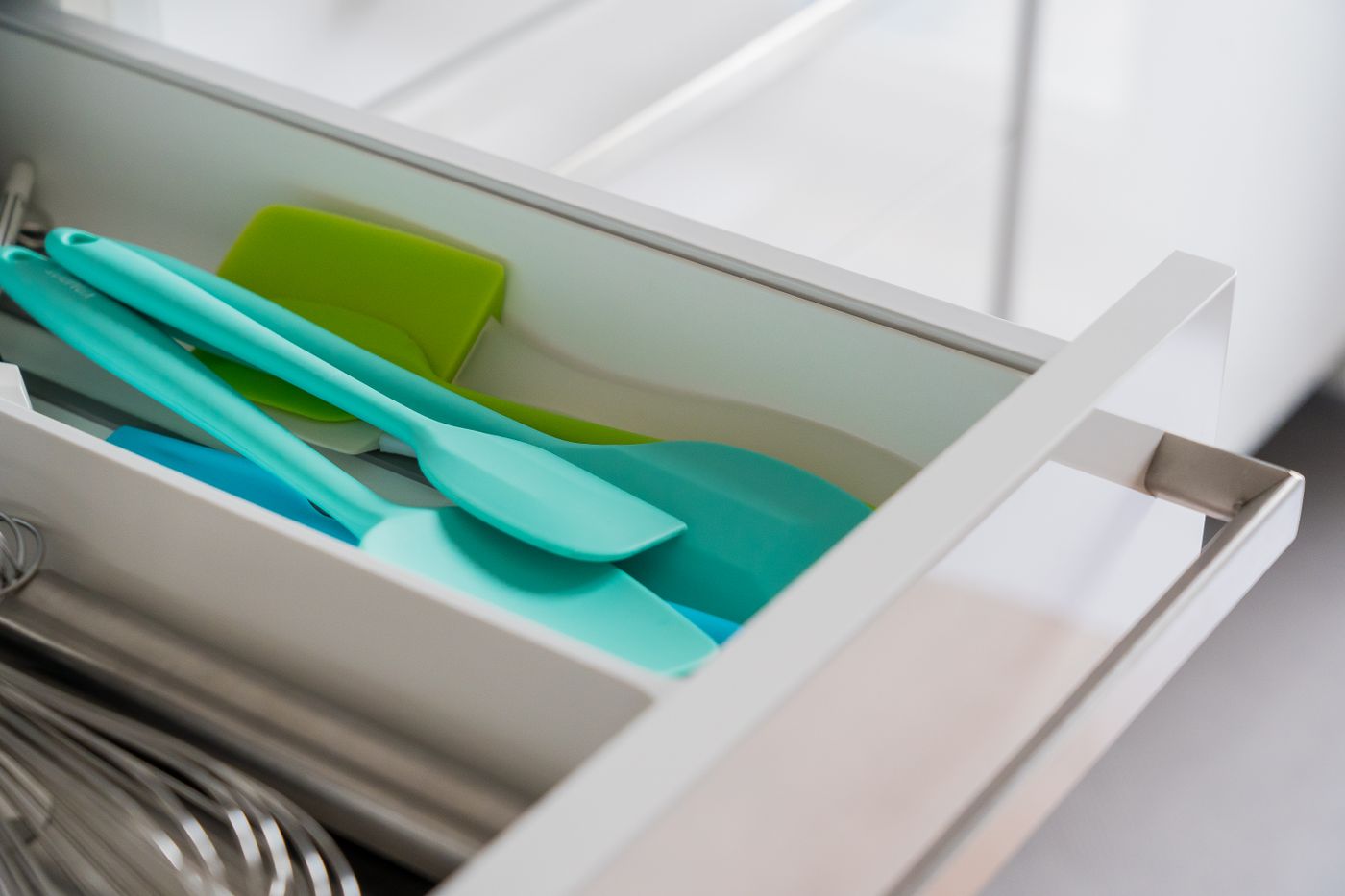
Silicone spatulas, baking moulds, lids and baby-feeding items look the same at every price point. The differences that matter, the cure system, the fillers and the post-curing, decide whether a product smells, transfers taste and passes a migration test. Some of that you can screen by hand. Compliance can only be proven by a lab, on the actual product.
What "food grade" means
There is no single global food-grade standard. It means meeting the rules of the market you sell into:
- EU: the framework Regulation (EC) 1935/2004 applies, but there is no harmonised EU measure for silicone. Germany's BfR Recommendation XV on silicones is the benchmark most labs and retailers use, including a limit of 0.5% volatile organic matter. Sold as "LFGB" testing, it usually adds a sensory test for odour and taste transfer.
- United States: FDA regulation 21 CFR 177.2600, on rubber articles intended for repeated use, is the one usually applied to silicone kitchenware. The FDA does not "approve" these products, so "FDA approved" on a box is a red flag, not a credential.
- EAEU: the Union's sanitary requirements for food-contact materials. See EAC certification.
Platinum or peroxide cure
- Platinum-cured silicone (addition cure, 铂金硫化 in Chinese) leaves few by-products, usually has little smell and costs more. It is common for baby products and premium ranges.
- Peroxide-cured silicone (过氧化物硫化) is cheaper. It leaves by-products that must be driven off by post-curing.
- Post-curing (二次硫化) means baking the finished parts, typically at around 200°C for several hours, to remove volatiles. Poorly post-cured parts smell, and are the ones most likely to fail the volatile-matter limit. Ask the factory which cure it uses and how it post-cures.
What you can check by hand: screening, not proof
- Smell. Open the bag and smell. A strong chemical smell means questions about the cure and the post-cure.
- Pinch and twist. Stretch or twist a flat section. White streaks suggest fillers. Some pigments mislead in both directions, so treat it as a hint.
- Heat test on a sample. Bake a sample at the claimed maximum temperature for an hour. Look for smell, discolouration, stickiness or deformation.
- Boil test. Boil a sample in water for ten minutes and smell the water.
- Colour bleed. Rub with a white cloth and a little cooking oil.
- Weight and thickness against the golden sample. Thinner and lighter often means a cheaper compound.
None of these proves compliance. They tell you which samples deserve a lab test, and which supplier to drop.
What only a lab can prove
- Overall migration into food simulants, and specific migration where it applies.
- Volatile organic matter, against the 0.5% limit in BfR XV.
- The sensory test for odour and taste transfer, for LFGB.
- Extractables under 21 CFR 177.2600 for the US.
- Heavy metals in the pigments.
Check that the report matches the product, the colour and the supplier, and that it is recent. Pigments differ, so test each colour, or agree with the lab which colours represent the worst case. A report on the raw silicone from the material supplier is not a report on your finished product.
Spec lines for your purchase order
Material: 100% silicone rubber, platinum-cured, or peroxide-cured with post-curing at a minimum of 200°C for at least 4 hours. Compliance: BfR Recommendation XV including sensory test (EU) and 21 CFR 177.2600 (US), as applicable to the destination. Test report per colour, issued within the last 12 months, with the supplier named as applicant. Maximum use temperature as tested and printed on the packaging. Batch code on cartons.
For mixed-material products, such as a silicone head on a nylon core or a wooden handle, every material in contact with food needs its own compliance evidence.
Red flags
- "FDA approved" printed on the product or packaging.
- A test report for a different colour, or for raw material only.
- A price well below comparable quotes, which usually means fillers or no post-cure.
- A temperature claim ("heat resistant to 250°C") with no test behind it.
FAQ
Is liquid silicone (LSR) better than solid silicone? Both can comply. Liquid silicone is usually platinum-cured and suits precise moulded parts; solid silicone is common for spatulas and mats.
What about baby products? Stricter. Drinking equipment for children has its own EU standard, EN 14350, and retailers add their own requirements.
Do I need a new test for a reorder? Not if nothing has changed and the report is recent, but ask the supplier to confirm in writing that the compound, pigment and process are unchanged. See the reorder trap.
Sourcing silicone kitchenware? We check test reports against the actual product during supplier verification, and screen samples before you approve them. More on food-contact rules in what food-contact certification actually means.
Tell us what you want to source.
Send a product link, a reference photo or a supplier quote. We recommend the next step.
Or WhatsApp +86 189 6983 1554